Chatbot vs AI Agent: What Your Business Actually Needs
The difference isn't on the vendor's homepage. It's in the third message of a real conversation.
Written by
xcale Team
Equipo xcale · The xcale Team
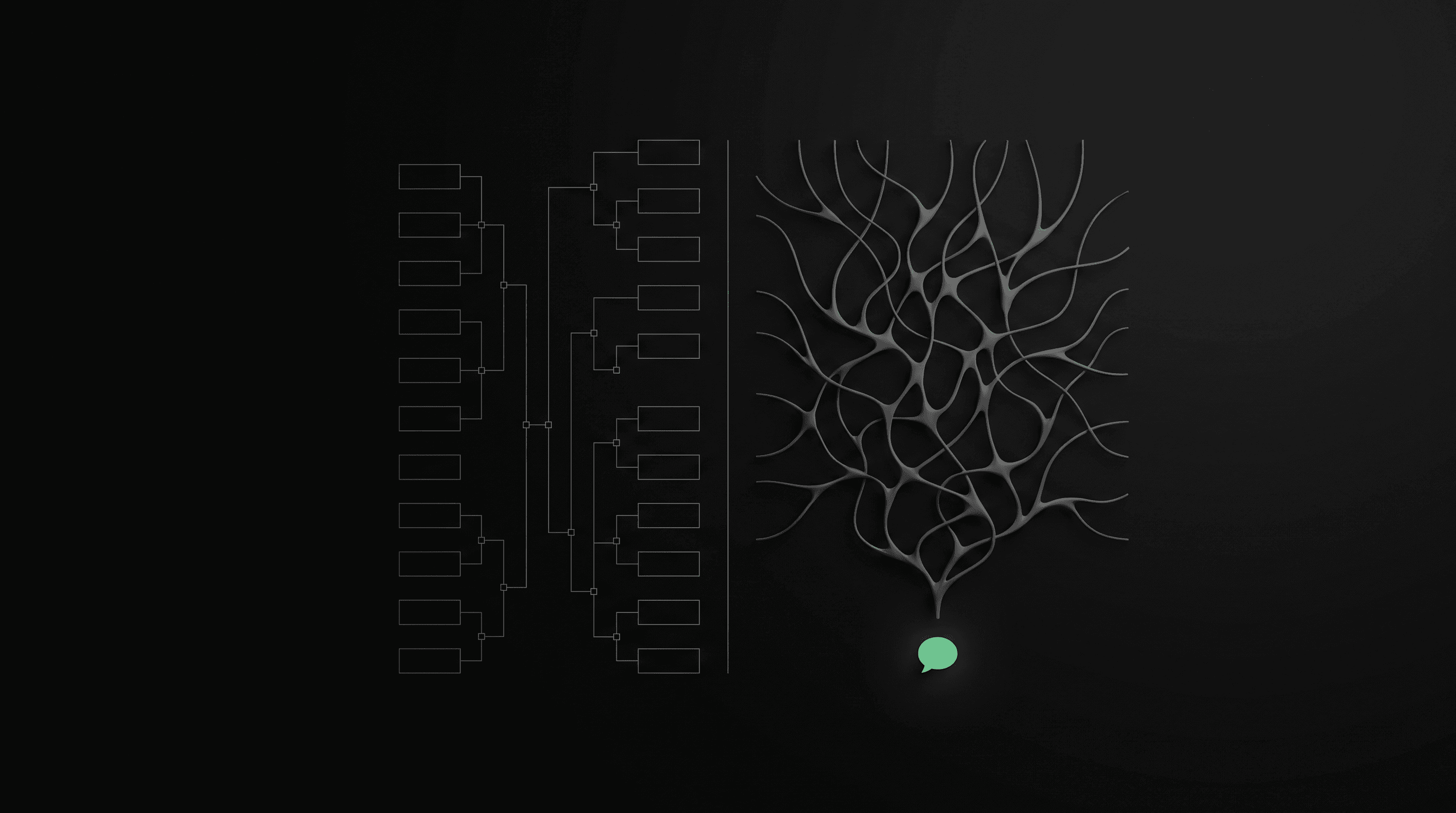
The chatbot vs AI agent question comes down to one test: what happens when a customer types something nobody planned for. A chatbot follows a path someone drew in advance. An agent decides the path at runtime, using your catalog, your calendar, and what it already knows about that customer. You won't see that difference on a vendor's homepage. You see it in the third message of a real conversation.
This is the buyer's guide for a small business owner evaluating WhatsApp automation who doesn't want to pay for “AI” that turns out to be a decision tree with a new label. What each one does, when a chatbot is genuinely the right call, when it starts costing you sales, and the questions that reveal which one you're being sold.
What a flow-based chatbot actually is
xcale
Try xcale free for 7 days
Your agent configured, connected to your stack, and answering on WhatsApp — in hours, not weeks.
A flow-based chatbot is a state machine: nodes, conditions, and replies written ahead of time. The customer sends a message, the system matches a keyword or a menu number to a branch, and returns the text attached to that branch.
Its strength is real and worth saying out loud: it is deterministic. It always says the same thing, it never improvises, you can audit the whole thing on one screen, and you can build it in an afternoon. For a single-path task — order status, store address, collecting five fields in order — that isn't a limitation, it's the right tool. WhatsApp's native in-chat forms (Flows) work for the same reason: the customer answers inside the thread, never opens a link, and the data arrives structured.
Its limit is structural too: only what someone anticipated exists. Every question outside the script lands in the same place — “sorry, I didn't get that, pick an option” — and the customer knows within a second that they're talking to a form.
A chatbot doesn't fail because it was written badly. It fails because only what someone anticipated exists.
What an AI agent does differently
An AI agent has no flow. It has four things: a goal, knowledge about your business, tools it can use, and memory of what already happened. From those it decides, on every message, what to say and what to do.
It interprets instead of matching
“hi, the black dress you posted yesterday — do you have it in medium, and how much with shipping?” To a chatbot that's three intents in one sentence with no usable keyword. An agent reads the whole sentence, identifies the product, checks the size against inventory, and quotes shipping.
It takes actions, not just turns
The practical gap between answering and resolving is tools. An agent with calendar access doesn't say “message us to book” — it offers two slots that are genuinely open, books the one the customer picks, and sends the confirmation. It's the same mechanism behind booking for a clinic, where an hour lost today doesn't come back tomorrow. With the store connected, it checks stock before recommending and generates the payment link — and connecting the store isn't a button: it's three different routes, with different limits.
It remembers between conversations
This is the widest gap. A chatbot starts from zero every time: to it, a three-year customer and a stranger are identical. An agent with persistent memory knows this number bought in April, asked about larger sizes, and has an open return. That's what makes the second sale cheaper than the first. That memory doesn't start on its own: it gets built in the first week after payment, the stretch that decides whether a new customer sticks or is lost —the job customer onboarding on WhatsApp covers.
It escalates on judgment, not on a keyword
A chatbot escalates when someone types “agent.” An agent recognizes that this is a complaint, a price negotiation, or a case outside policy, and hands it to a person with the context already summarized.
The differences you can see in the thread
- An unplanned question. Chatbot: main menu. Agent: answers from your knowledge base, or says it doesn't know and escalates.
- A topic switch mid-task. The customer was booking and asks whether you take cards. The chatbot loses the thread or restarts it; the agent answers and picks the booking back up.
- A returning customer. Chatbot: “Hi! How can I help you today?” Agent: continues where the last conversation ended.
- Data that changes daily. Prices, stock, availability. In a flow they're text somebody has to go edit; an agent queries the source at message time.
- Maintenance. A new product means new nodes in a chatbot. In an agent, it means one updated document in the knowledge base.
When a chatbot is enough
A well-built chatbot beats a badly configured agent. Pick the chatbot if:
- Volume is low — a few dozen chats a month that one person can answer.
- The questions are always the same three: hours, location, directions.
- The job is routing to a human team, not handling the conversation.
- You need to collect fields in a fixed order. A WhatsApp Flow does that better and cheaper than any agent.
- Every word has to be identical for compliance: legally approved copy in healthcare or finance.
If that's your case, don't pay for an agent. The cost of automation isn't the subscription, it's the hours spent configuring it.
When a chatbot starts costing you sales
Five signals you can measure in your own WhatsApp this week:
- Chats that end at the main menu or in silence. Count how many of your last 50 died there.
- Customers asking for a human within two messages. That's the customer's verdict on your bot.
- Catalog questions with variants. Size, color, availability, compatibility — where flows multiply beyond control.
- Pricing that depends on the case. If building a quote requires understanding, a decision tree won't do it.
- Repeat purchase. If your business depends on customers coming back, amnesia is charging you the difference.
And the scheduling signal: if your volume peaks at night and on Sundays, the script isn't the problem — nobody being there is. Our WhatsApp sales playbook covers that process end to end.
What each option really costs
Both run on the same infrastructure: the WhatsApp Business API. Since 1 July 2025 Meta bills per delivered template message — not per 24-hour conversation — at a rate set by the recipient's country and the message category; free-form replies inside the window a customer opens aren't charged, though from 1 October 2026 Meta starts billing them per message. That cost is identical whether a chatbot or an agent is answering, so budget it from Meta's official table for the markets you sell in, and read what running on the API involves first.
What differs is the labor. A chatbot is cheap to start and expensive to keep: every new product, promotion, or exception is another node, and the person maintaining it is on your team. An agent gets configured once — knowledge, tools, escalation rules — and is then updated by editing documents rather than diagrams. If your catalog or your prices move often, that's where the real cost difference sits.
How to tell what a vendor is selling
Almost every platform says “AI” now, and the vocabulary doesn't help either: “chatbot,” “WhatsApp automation” and “conversational flow” all name a tool somebody has to configure and maintain. A small business rarely has that somebody, which is why AI agents for SMBs get bought differently from enterprise software. Five questions separate the two categories:
- Where do I configure behavior? If the answer is a canvas with nodes and arrows, it's a chatbot — even if one node is labeled “AI.”
- What exactly happens when a customer asks something unplanned? “It hits the fallback” is one answer. “It checks the knowledge base, and escalates if the answer isn't there” is a different product.
- What does it remember about a customer who returns in three weeks, and where does that memory live? If it's CRM tags and fields, that's a record, not conversational memory.
- Which actions can it take on its own? Ask for the specific list: inventory, calendar, payments, shipping. “It integrates via webhook” means you build the action.
- How does it decide to escalate, and what does the human receive?
Then the test that doesn't lie: ask to type into a live conversation instead of watching a recorded demo. Send something off-script. Those questions land better with a specific name in front of them: the written comparison, platform by platform, is in xcale vs ManyChat and xcale vs Treble.ai.
How to choose
Short rule: if you can draw your conversations, draw them. A chatbot will serve you and it costs less. If your conversations depend on your catalog, your calendar, and who the customer is, a decision tree will never catch up — you'll be adding branches forever.
And if the answer is the agent, the next decision isn't which one — it's how many. Selling, supporting and scheduling are three different jobs, and they work better as separate roles, each with its own tools and escalation rule, than as one bot doing all three.
xcale builds the second one: agents that run on WhatsApp with goals, connected tools (store, calendar, payments), a knowledge base holding your catalog and policies, and persistent memory per customer. AI takes the repetitive part and escalates exceptions to a person — at Dra. Duarte Medicina Estética, a clinic running this way, 15% of chat conversations end in a booked appointment. How those layers get configured is laid out in features.
If you'd rather see the difference on your own data than read about it, xcale starts at $49/month with a 7-day free trial.
Frequently asked questions
A chatbot follows a flow defined in advance: it matches keywords or menu numbers and returns fixed text. An AI agent interprets the actual message, looks up information about your business, takes actions (booking, quoting, checking stock), and remembers the customer between conversations. The chatbot is predictable but limited to what someone anticipated; the agent decides the path at runtime.