WhatsApp Service Messages Pricing: Replying Stops Being Free on 1 October 2026
Meta starts charging for every reply sent inside the 24-hour window. What changes, what stays free, and what is worth checking before October.
Equipo xcale9 min read
What actually changes on 1 October 2026
On 1 October 2026 Meta starts charging, per message, for every service message on WhatsApp — the replies your business sends to a customer inside the 24-hour window. The sentence is Meta's own: "Effective October 1, 2026 - Meta will charge on a per-message basis for all service messages... These messages have not been charged since November 1, 2024". That is the whole of WhatsApp service messages pricing in one line, and it reverses a rule that has held for almost two years.
A second change lands on the same date and is getting far less attention: utility templates sent in reply to a customer, inside that same window, become chargeable too. Those had been free since 1 July 2025. The order confirmation you fire two minutes after the customer writes goes from costing nothing to costing a utility rate.
A third one is already in force, since 1 August 2026: Meta Business Agent — Meta's own agent — is billed per token, in a single charge that covers both model processing and message delivery.
The combined effect shows best in Meta's own worked example. A one-hour conversation: a marketing template, two replies from Meta's agent, one reply typed by a human, and an order confirmation. As of 1 July 2026 that produced one charge. As of 1 August, three. As of 1 October, five. Same conversation; what changed is what counts.
Meta charges for the messages a business sends to a user. Receiving still costs nothing.
The payment method: what Meta publishes, and what providers report
If every reply is billed from 1 October, the account has to be billable. That makes the payment method on a WhatsApp Business Account an operational requirement rather than paperwork: an account with nothing on file in Billing Hub has no way to pay for what was free through September.
That much is arithmetic. What follows is a warning about sourcing, and it includes us. A great many providers and agencies state that the cut-off is 30 September 2026, and that after that day Meta stops delivering service messages for accounts with no payment method. That date is not on Meta's pricing page for non-template messages, which is the source for everything else in this guide: we read it again on 21 September 2026 and neither the date nor the delivery cut-off is there. Nor is the Visa and Mastercard availability for Meta Business Agent that circulates with a date of its own.
In practice the task is sound and the date is not ours to assert. If you work through a platform, a BSP or an agency, it is a one-line question to ask today and to get in writing: do we have a payment method on file for our WhatsApp Business Account, and which deadline applies to us? If you are integrated straight against the Cloud API, it is a check in Billing Hub. Whoever hands you a date should be able to say where it came from.
What stays free
Four things, and the fourth comes with a warning about sourcing. They are worth knowing precisely, because they change how a conversation should be designed.
- The 24-hour window does not go away. What changed is that replying inside it is no longer free. The customer still opens it, and it still resets with every message they send. Non-template messages can only be sent inside it: they exist to respond, not to reach out.
- The 72-hour free entry point window is unchanged. Conversations that start from a click-to-WhatsApp ad or a Facebook call-to-action button carry no delivery charge for 72 hours, across marketing, utility, authentication and service messages.
- Meta Business Agent messages are not free there. Inside that same 72-hour window, Meta's agent still bills its tokens. It is the only category in Meta's table with a "No" in that column.
- The first 1,000 service messages of each month, if the providers are right. 360dialog and SendPulse both publish an allowance of 1,000 service messages per business phone number per month: billing starts at the 1,001st delivered, the allowance resets monthly and does not roll over. It is not on Meta's pricing page for non-template messages, re-read on 21 September 2026. A thousand messages a month is about thirty-three a day, which for a great many businesses decides the entire invoice — so it is worth asking for in writing before you budget.
What WhatsApp service messages pricing will look like
Meta defines the rate by rule rather than by a single global number: a service message will cost the same as a utility or authentication message in that market, and the market is set by the recipient's country, not yours. Meta committed to publishing those rates by 1 September 2026. As of 21 September its pricing page still promised them in the future tense — "no later than September 1, 2026" — and still offered only the rate cards in force since 1 July. The October card is circulating through providers rather than through the page that announced it. Meta reserves the right to update it as often as quarterly.
Two details move an SMB's arithmetic more than the rate itself:
- There are no volume tiers for service messages. Utility and authentication keep theirs. Replying more does not make replying cheaper.
- Delivery is what gets billed, not sending. A message that isn't delivered isn't charged.
The one figure Meta publishes as an example is Brazilian: 0.68 US cents per delivered message, the utility and authentication rate in force there as of 1 July 2026. That is not Colombia's rate and not Mexico's — yours is in the rate card, by market and by currency — but the exercise transfers: multiply your rate by the number of messages you send while replying, not by the number of conversations.
And that is the number almost nobody has measured. If your team answers in six short messages what fits in two, your October invoice won't be set by Meta's rate. It will be set by how your business writes.
Meta Business Agent and your own AI agent are billed differently
Since 1 July 2026 there are two categories of non-template message, and the difference decides the bill.
- Meta Business Agent. The message is produced by Meta's agent platform and billed per token: a single global rate of US$2.00 per million tokens. Meta estimates a message consumes 20,000–25,000 tokens, which works out at roughly 4–5 US cents per message. Its own examples: a simple question ("what time do you open?") resolved in 4 messages, about 16–20 cents; a complex problem resolved in 10 messages, about 40–50 cents.
- Service. Any non-template message not powered by Meta Business Agent — typed by a person or produced by a third-party AI solution. Billed per message, at that market's utility rate.
Meta is explicit that putting those two prices side by side is not a like-for-like comparison, because a business running third-party AI pays for that AI separately, and a business running people pays for the people. That caveat is fair, and it is worth repeating before someone uses it on you as a sales argument: an honest comparison adds the cost of the message to the cost of whoever writes it.
What is a plain fact of Meta's table, and the one that matters most to a business that runs ads: inside the 72-hour free entry point window a service message is not charged and a Meta Business Agent message is. If your traffic arrives through click-to-WhatsApp ads, that asymmetry shows up on the invoice.
What changes in an SMB's day-to-day
None of this makes WhatsApp an expensive channel. It makes it a metered one, which is different, and it puts a price on three habits that cost nothing until 30 September.
- Padding the thread. "Hi", "one moment", "let me check", "all set" is four delivered messages and, from October, four charges. The same thing said once costs once.
- Replying late and in batches. A timely reply closes the matter in a few messages. A reply the next day forces both sides to rebuild context and stretches the thread.
- Not knowing what you get asked. Your ten most repeated questions are the ones you will pay to answer most often. Documented properly and answered completely the first time, they get paid for once.
In August we wrote that replying inside the window cost nothing, and it did: how to run AI customer service on WhatsApp is still the guide to building it, with one line to add — from October the clock has a price too. The same applies to onboarding sequences: the utility template you used to send free inside the window now lands on the bill.
The metric worth starting to watch today, before the first invoice arrives, is messages sent per resolved conversation. Not replies per minute, not deflection rate: messages per resolved conversation, and how many of those conversations end in something concrete — an appointment, an order, a booking.
It also changes what you should demand of a platform. Three useful questions: whether it shows you how many messages it sends per conversation, whether it resolves in the first exchange or stretches the thread, and what it charges on top of Meta's rate. The rest of the billing model is in our WhatsApp Business API guide; what an agent does with your knowledge base and your escalation rules is in features; and our own plans are in pricing, with a 7-day free trial — enough to measure your own conversations before October.
What to do this week
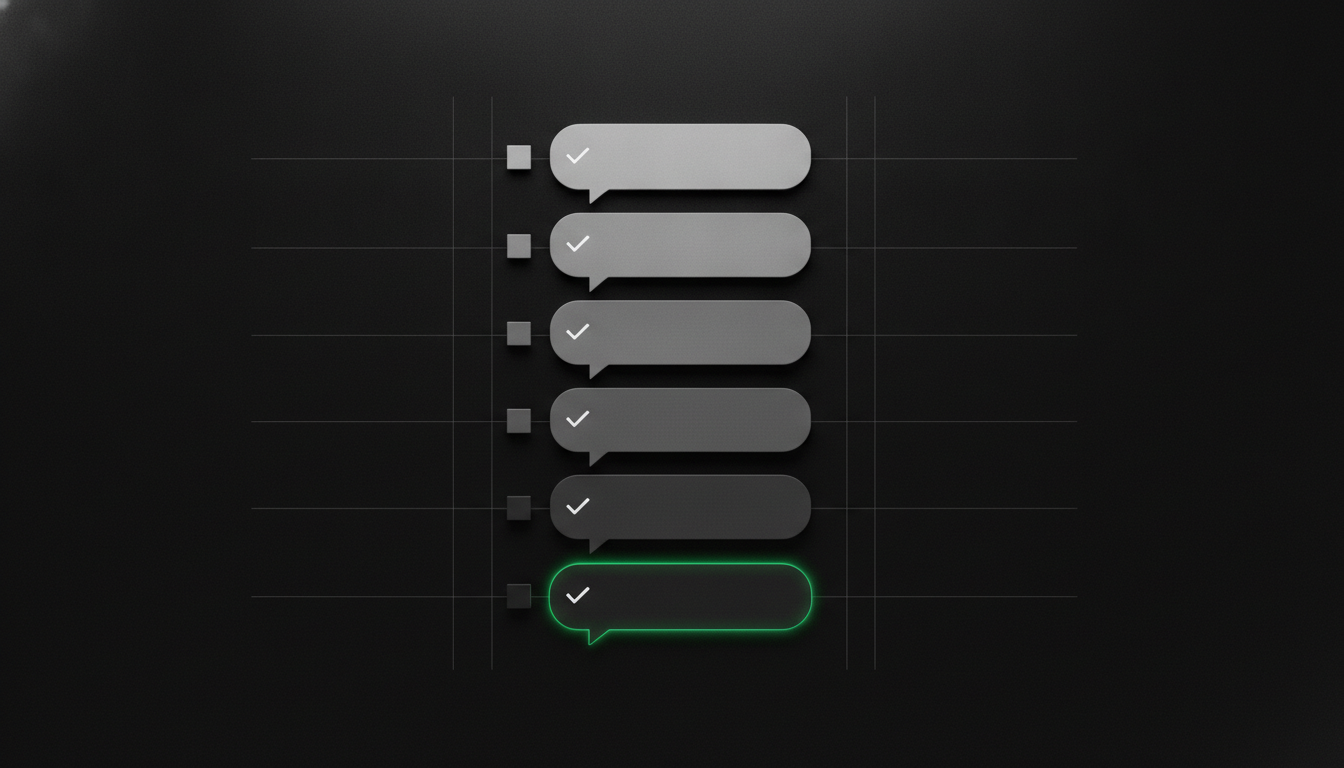
- Confirm the payment method on your WhatsApp Business Account. From 1 October every reply is billed, so the account has to be billable. If you work through a provider, ask for it in writing — and ask which deadline applies to you and where it came from.
- Count your messages. Take twenty conversations from last week and count how many messages you sent in each. That average, multiplied by your utility rate, is the order of magnitude of your October invoice.
- Separate what a person answers from what a system answers. From 1 October both are billed the same way, so it is worth knowing the split beforehand.
- Document your ten most repeated questions, with the good, complete answer in a single message. It is the cheapest way to bring the bill down.
- Review your utility templates — confirmations, shipping notices, reminders. The ones you send inside the window stop being free; the ones that reopen a closed conversation always cost.
One note on method. Everything above comes from Meta's pricing page for non-template messages, re-read on 21 September 2026, and from the per-market rate cards it publishes. That is what to re-read in October — not a vendor's summary, this one included. And one correction, for the same reason: the first version of this guide, published on 6 September 2026, presented the 30 September deadline as a line from Meta's documentation. It is not — providers report it — and this text has said so since 12 September.
Frequently asked questions
When does Meta start charging for WhatsApp service messages?
On 1 October 2026. Meta charges per delivered message for all service messages — the replies a business sends inside the 24-hour window opened by the customer. Those messages had not been charged since 1 November 2024. On the same date, utility templates sent in reply to a customer inside that window also become chargeable; they had been free since 1 July 2025.
How much does a WhatsApp service message cost?
Meta publishes no single global price: a service message costs the same as a utility or authentication message in that market, and the market is set by the recipient's country, not the sender's. As of 21 September 2026 the October rate card had still not been published — Meta's pricing page promises it in the future tense and offers only the cards in force since 1 July 2026, downloadable per currency, Colombian and Mexican pesos among them. The October tables in circulation come from providers. There are no volume tiers for service messages; utility and authentication keep theirs.
Is replying inside the 24-hour window still free?
Not from 1 October 2026. The window itself still exists and still opens and resets with every customer message, but the replies you send inside it become billable per delivered message. What does remain free of delivery charges is the 72-hour free entry point window opened by click-to-WhatsApp ads, across marketing, utility, authentication and service messages.
Do I need a payment method on file to keep replying on WhatsApp?
Yes — from 1 October 2026 those replies are billed, and an account with no payment method on file in Billing Hub has no way to pay for them. On the deadline itself it is worth being precise: many providers state the cut-off is 30 September 2026 and that Meta stops delivering service messages afterwards, but that date is not on Meta's pricing page for non-template messages, re-read on 21 September 2026. Treat it as a requirement to confirm in writing with your provider, not as a deadline Meta has published.
Is Meta Business Agent cheaper than a third-party AI agent?
It is not a like-for-like comparison, and Meta says so explicitly. Meta Business Agent is billed per token — US$2.00 per million tokens, roughly 4–5 US cents per message by Meta's own estimate — with the AI included in that charge. A message written by a person or by third-party AI is billed as a service message at the market's utility rate, and the cost of that AI or that person sits on top. An honest comparison adds both parts. One extra data point: inside the 72-hour free entry point window a service message is not charged and a Meta Business Agent message is.
Has Meta published the service message rates that take effect on 1 October 2026?
Not on its own pricing page. Meta committed to publishing them by 1 September 2026, and as of 21 September that page still announced them in the future tense and still offered only the rate cards in force since 1 July 2026. The per-country tables circulating now come from providers and BSPs, not from the documentation. The rule itself is published: a service message will cost the same as a utility or authentication message in the recipient's country, with no volume tiers.